
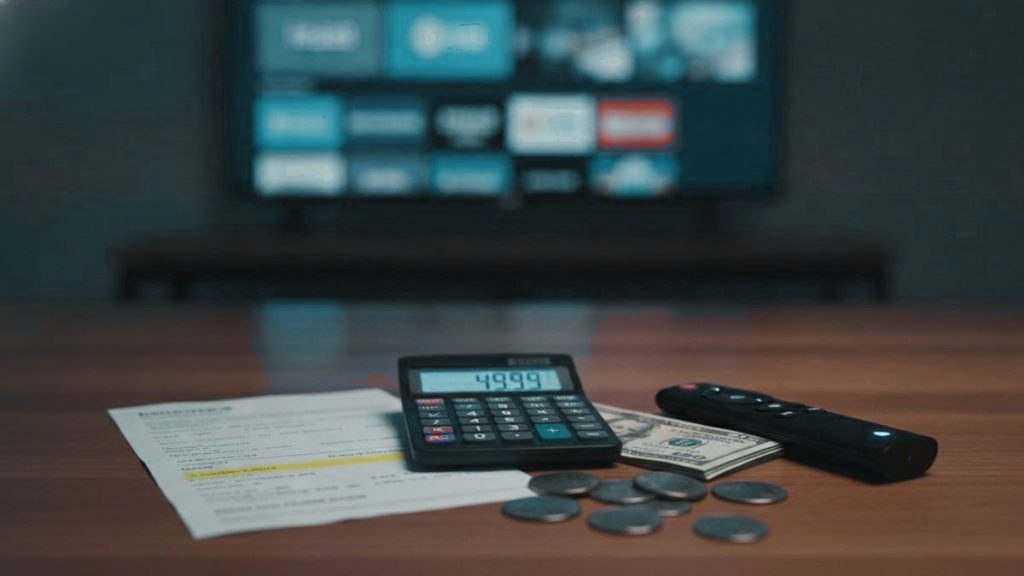
A line on this site costs $15 for one month or $69 for twelve on a single connection, and the wider independent market sits between roughly $10 and $25 a month or $55 and $120 a year. Those are the numbers. The more useful question is what the money is actually paying for, because the dominant cost in this business is capacity at nine in the evening, and a price that looks remarkable is usually a price that has not bought any.
The short answer, and the number underneath it
$69 for a year works out at $5.75 a month. A five-connection year at $239 works out at just under $4 per connection per month. Per connection per month is the figure worth comparing between providers, and it is almost never the figure they advertise.
What a stream costs to move
Start with arithmetic rather than opinion. A 4K feed in HEVC typically runs around 16 Mbps. That is 2 megabytes every second, or about 7.2 GB an hour. A household watching three hours a day on one 4K connection moves roughly 650 GB a month. The same household on HD feeds at 5 Mbps moves closer to 200 GB.
Now multiply. A provider with a thousand people watching 4K at the same moment is pushing about 16 Gbps in that moment. Not on average across the month, which is a much smaller and much less expensive number, but at the exact minute a popular match kicks off, which is when everybody wants it and when nothing can be deferred.
That is the whole economics of this market in one paragraph. Capacity has to be bought for the peak, not for the average, and it sits idle most of the day. Every provider is making the same decision about how much of it to pay for, and the buyer cannot see the decision from the outside. The price is the closest thing to a visible clue, which is why a figure well below the market band tells you something real.
The published ladder
| Term | 1 connection | 2 connections | 3 connections | 5 connections |
|---|---|---|---|---|
| 1 month | $15 | $25 | $35 | $49 |
| 3 months | $29 | $49 | $65 | $99 |
| 6 months | $45 | $75 | $99 | $149 |
| 12 months | $69 | $119 | $159 | $239 |
Every one of those figures is on the pricing page as well, in the same shape, and none of them changes because you asked by message instead of reading it. A provider that quotes privately is pricing you individually, which is worth noticing before you go further.
A connection is not a device
This is the part people buy wrong, and it costs them either money or an argument on a Saturday. A connection is one stream playing at one moment. It is not a registration, and it is not tied to a particular television.
You can put the same login on a Fire TV stick, a bedroom set, a laptop and two phones. With one connection, exactly one of them can be watching at a time; start a second and the first typically drops. So the question to answer before choosing a plan is not how many screens you own, it is how many of them might be showing something simultaneously on a weekend evening. For most households that is two. For a family with sport in one room and children in another, three.
| Plan | Yearly price | Per month | Per connection, per month |
|---|---|---|---|
| 1 connection | $69 | $5.75 | $5.75 |
| 2 connections | $119 | $9.92 | $4.96 |
| 3 connections | $159 | $13.25 | $4.42 |
| 5 connections | $239 | $19.92 | $3.98 |
Why twelve months costs less per month than one
The discount from $15 a month to $5.75 is large enough to look like a trick, so it is worth setting out where it comes from. Three costs genuinely fall away.
Payment handling. Every transaction carries a processing fee with a fixed component. On a $15 sale that fixed part is a meaningful slice of what is left. Collecting once rather than twelve times removes eleven of them.
Support concentration. Most of the support any account ever generates happens in its first week: installing a player, entering credentials, waiting for the guide to populate, working out why one channel will not play. An annual subscriber goes through that once a year. A monthly subscriber who lapses and returns goes through parts of it repeatedly.
Capacity planning. Peak capacity has to be committed in advance. Known subscribers make that a calculation; unpredictable ones make it a guess, and guesses are bought with a margin for error that somebody pays for.
None of which makes twelve months the right first purchase. Buy a month, run it through a full weekend, and take the annual price on the second purchase when you already know what you are buying.
What the market charges
| Term | Typical independent range | Works out at | What sits below the range |
|---|---|---|---|
| 1 month | $10 to $25 | $10 to $25 a month | Trial credit sold as a plan |
| 3 months | $25 to $45 | $8 to $15 a month | Reseller credit priced to clear |
| 6 months | $40 to $70 | $7 to $12 a month | Thin capacity, no support desk |
| 12 months | $55 to $120 | $4.50 to $10 a month | A year sold by someone not planning one |
Our figures sit inside those bands on purpose rather than underneath them. Anyone can be the cheapest line on a list for one season; the cost of doing it is paid by the people who bought the year.
The tier that sells a year for $20
There is a persistent layer of offers at $20 or $25 for twelve months, and it deserves arithmetic rather than accusation. Most are resellers buying credits in bulk from somebody upstream and pricing below their own replacement cost to move volume. The account usually works perfectly on the day it is issued, which is why the tier survives.
What fails is everything afterwards. Go back to the 16 Gbps figure: a year at $25 is about $2 a month, from which servers, bandwidth at peak, guide maintenance and somebody answering messages all have to come. Something has to be cut, and what gets cut first is peak capacity, because it is the largest line and its absence is only visible for a few hours a week. Support goes next, because it was never priced in at all. And when the upstream supplier stops the reseller, every account they sold stops at the same moment, with nobody to ask and nothing to refund.
The test is not whether a price is low. It is whether the arithmetic behind it survives a busy Saturday.
What the price does not buy
Being straight about this is more useful than a longer feature list.
- It does not buy a licence you can inspect. Rights in this market are rarely visible from the outside, ours included. Our guide to where US law puts the liability covers that honestly rather than reassuringly.
- It does not buy a guarantee that a particular channel stays. Feeds appear and disappear for reasons outside any reseller’s control. Anyone promising a specific channel for a year is promising something they cannot hold.
- It does not buy an audited uptime figure. We publish 99.9%, and like every number of that kind in this market it is ours rather than an auditor’s. What you can verify is how it behaves on your own line during the trial.
- It does not fix your own chain. No subscription improves Wi-Fi at nine in the evening, an underpowered stick or a television left in showroom picture mode. Those are yours, and the chain explainer shows how to check each link.
The costs that sit outside the line
| Item | One-off cost | What it actually solves |
|---|---|---|
| What you already own | $0 | A 2016 or later smart TV, a phone or a laptop will do for testing tonight |
| Ethernet adapter | $12 to $15 | Stalling caused by Wi-Fi. The highest-yield purchase on this page |
| 4K stick | $30 to $60 | An older television with a slow or limited app platform |
| Wired Google TV device | $50 to $100 | The same, with a network socket already fitted |
| Shield, Formuler or MAG | $150 to $200 | A main television watched daily, and a better remote |
| Player app | $0 to about $10 | Free on nearly every platform; TiViMate Premium is around $10 a year |
If you buy exactly one item from that table, buy the adapter. Most stuttering is a network problem wearing a hardware costume, and the hardware guide goes through which chip is worth paying for and which spec-sheet line is noise.
A first year, and every year after it
| Item | Cost |
|---|---|
| One month first, to test properly | $15 |
| Then twelve months, one connection | $69 |
| Fire TV stick, if the television needs one | $40 |
| Ethernet adapter | $12 |
| First year, worst case | $136 |
| Every year after | $69 |
What it is replacing, in numbers
A US cable or satellite package with live sport generally lands between $80 and $120 a month once equipment rental and regional fees are counted, which is $1,000 to $1,400 a year. Licensed live-TV streaming runs from roughly $28 a month for a small entertainment package to around $85 for a full one, so $340 to $1,000 a year, at the time of writing and rising most years.
Against $69, the gap is not subtle, and it is the gap rather than the channel count that actually moves people. What the licensed services have in exchange is a rights position you can verify, which is a real thing to be buying and worth weighing honestly.
When the arithmetic does not work for you
It works if you follow live sport across several competitions, want channels from another country that no domestic package carries, or are paying a large bill mainly for a handful of channels.
It does not if you almost only watch box sets and films on demand. A mainstream streaming platform serves that better, with fewer moving parts and a licence you can check. Live television is what this technology is good at, and capability you never use is poor value at any price.
Paying without regret
- Use the 24-hour trial at a peak hour. No card, and a Saturday evening tells you what a Tuesday morning never will.
- Buy one month first, however good the annual figure looks. The year is still there in four weeks.
- Count connections, not televisions, and count them for the busiest evening of your week.
- Read the refund terms before paying. Ours run to 7 days and are a page on this site, not a promise in a chat window.
- Never send card details in a message thread, to us or to anyone else.
- Treat countdown timers as decoration. A provider that will be trading next month is still charging the same next month.
Questions this raises
How much does IPTV cost per month?
One month on a single connection is $15 here, and independent providers generally sit between $10 and $25. Paying for twelve months brings the effective rate down to $5.75 a month. Multi-connection plans do not scale linearly: two connections are $25 a month or $119 a year, because the second stream costs capacity but not another support relationship.
How much is an IPTV subscription for a year?
A twelve-month line on one connection is $69 on this site. Across the independent market a year usually falls between $55 and $120 for a single connection, and a price well below that band has almost always been made possible by not buying capacity for the peak hour. Five connections for twelve months are $239, which is just under $4 per connection per month.
How much does IPTV cost for more than one screen?
A twelve-month line is $69 for one connection, $119 for two, $159 for three and $239 for five. The number that matters is simultaneous connections rather than installed devices: the same login can sit on every device you own, but a one-connection plan plays on one of them at a time. Count the screens that might be watching at once on a weekend evening.
Is a lifetime IPTV subscription worth buying?
No. Bandwidth, servers and support are recurring costs that a single payment cannot cover, so a lifetime offer only works out for the seller if the service stops before it works out for you. No reseller can promise permanent access to channels it does not own. Providers that intend to be trading next year sell terms of up to twelve months, which is why ours stop there.
Are there hidden costs with IPTV?
Not from the line itself, and there should never be an activation, setup or maintenance fee. Outside it you may want an Ethernet adapter at $12 to $15, which is the highest-yield purchase available, a 4K stick at $30 to $60 if your television is old or slow, and possibly a paid player tier such as TiViMate Premium at around $10 a year. Players are otherwise free on nearly every platform.
How does the cost compare with cable?
A US cable or satellite package carrying live sport generally lands between $80 and $120 a month once equipment and regional fees are included, so $1,000 to $1,400 a year. Licensed live-TV streaming runs from about $28 a month for a small package to around $85 for a full one. A twelve-month line here is $69. The licensed services cost more and offer a rights position you can actually verify.
Want to see how it holds up on your own screen?
Message us and the line is open in under 15 minutes. You have 7 days to decide it earned its place.
Read next
Choosing an IPTV Box: Which Chip Decodes What, and Why
A box pulls the data, decodes it and hands a finished picture to the panel. Which chip decodes what, why AV1 is…
September 4, 2026IPTV Player Apps: The Four Jobs a Player Actually Does
A player decides how much stream to hold before it starts, which decoder gets the frames, and where the programme guide comes…
August 31, 2026Is IPTV Legal in the US? The Rights Chain, Explained Plainly
The technology is lawful and ordinary. In the United States, liability attaches to unlicensed retransmission, and both criminal and civil actions have…